Speakers at the Impact Investor Seminar held in Seville last week as part of the IPE Conference & Awards discussed the evolution of Spain’s impact ecosystem and the role of impact investing within institutional portfolios.
Spain’s impact investment sector is seeing a continued surge in institutional interest, with institutional investors beginning to take up a more prominent role in a market historically dominated by private capital, delegates at last week’s Impact Investor Seminar in Seville heard.
The seminar, held under the umbrella of the annual IPE Conference & Awards, opened with an update of the Spanish impact investing ecosystem, presented by Iñigo Serrats, co-founder and managing partner at Madrid-based impact investor Impact Bridge.
Speaking on behalf of SpainNAB, Spain’s GSG Impact’s national partner, Serrats explained the country’s impact ecosystem is developing quickly but remains small compared to some of its European peers, constrained by limited scale, regulatory uncertainty and the need for stronger data and track records.
According to a market study published last year by SpainNAB and Esade Center for Social Impact last year, the Spanish impact investment market grew to €3.34bn at the end of 2023, a 135 % increase since 2020.
Serrats said that a combination of rising investor appetite, a growing pipeline, clearer policy signals and a broader range of investment vehicles all indicate that Spain is well positioned for its next stage of impact finance growth.
Key actors
In a panel discussion moderated by Impact Investor’s co-editor Paula Garrido, three of the most active impact investors in the country – GAWA Capital, Impact Bridge and Ship2B Ventures – shared views on the main barriers preventing further growth in the sector and agreed on the increased interest from institutional investors in their funds.
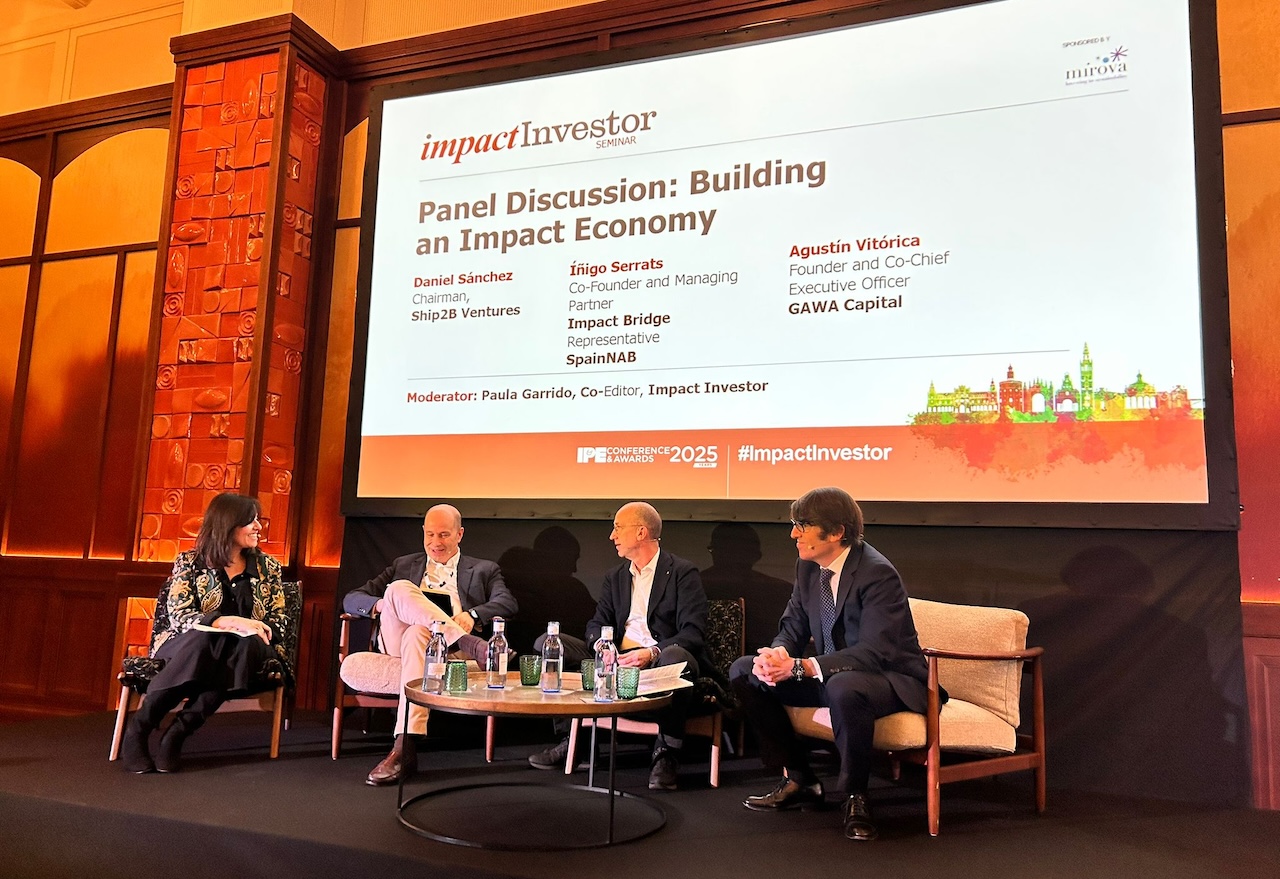
Agustín Vitórica, founder and co-CEO of GAWA Capital, said they currently raise most of their capital from institutional investors. “Now we are fundraising for our fourth fund, 90% of which comes from institutional investors, including pension funds, insurance companies, and international institutions,” he said.
Established in 2009, GAWA’s focus is on improving the lives of low-income communities by promoting investment in social enterprises, whilst also providing a financial return to investors. It currently has over €200m under management and has so far made 57 investments across 17 different countries.
Daniel Sánchez, chairman of Barcelona-based Ship2B Ventures, spoke about the recent launch of their latest social impact fund, a blended finance vehicle which achieved a first close of €65m. The structure, he explained, allows for the combination of institutional capital with investment-protection mechanisms, including “first-loss coverage which was key to attract private investors”.
Impact Bridge’s Serrats added that the strong financial performance of their funds during recent difficult years, has been crucial to attract more institutional investors. “We now have some 15 pension funds investing across different strategies, and for most of them it is the first time invest in impact.” Impact Bridge manages different strategies across asset classes and impact themes including a €150m impact debt fund.
European pension funds
On a panel moderated by Impact Investor’s co-editor Maha Khan Phillips, speakers talked about how impact is being incorporated more systematically into the strategic allocation of pension funds, moving beyond theory and into action. Panellists discussed impact sectors and themes, perspectives of risk, as well as the challenges and opportunities that impact investing presents in a world increasingly being shaped by regulatory change, geopolitical pressures and a rapidly evolving definition of fiduciary duty.
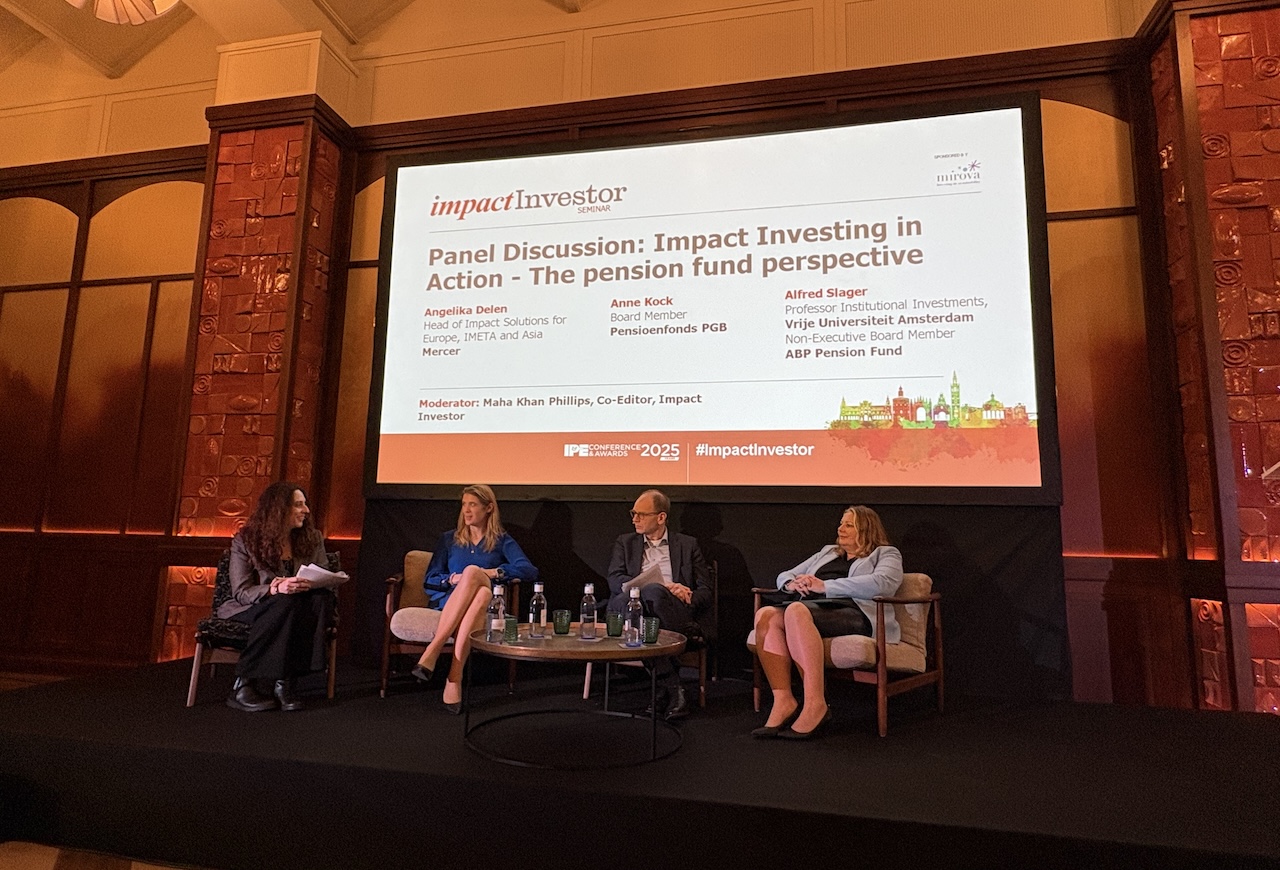
Anne Kock, board member at the Dutch pension fund Pensioenfonds PGB , said that she feels impact investments can be best done in the fund’s private portfolio.
She added that the fund is prioritising themes such as climate, food and health, and intends to increase its exposure to European opportunities to support resilience where the fund’s beneficiaries live.
“We are trying to move to a holistic approach… it requires a more realistic approach [to] investment strategy and a different skillset.”
It also involves developing a new culture within the organisation, as well as recognising that trying and even making mistakes is part of the learning process, she said.
Despite the increasing institutional interest, several panellists pointed to barriers that still hinder institutional participation.
Speaking on the issue of investment governance, Alfred Slager, professor of institutional investments at Vrije Universiteit Amsterdam and non-executive board member at ABP Pension Fund warned of challenges around impact data.
“The problem isn’t needing more data, it’s having too much […] we need more relevant data and metrics that actually matter,” he said, stressing the need for improved methodologies and consistency across organisations, particularly during board transitions.
Panellists also discussed tensions between institutional scale requirements and early-stage impact opportunities. Angelika Delen, head of impact solutions for Europe, IMETA and Asia at Mercer observed that rigid minimum ticket sizes can limit market development. “Impact gives you the opportunity for innovation […] why not have one or two smaller tickets of €5–10m rather than always going to €30m?” she said.
The discussion ended with speakers providing a view on the outlook for the sector, highlighting that more commitment is needed from the investment community to drive impact forward.